

Every time a patient is wheeled from the ER to radiology, from a recovery room to surgery, or across a hospital wing for a routine transfer, the bed’s mobility system is doing quiet, critical work. It has to move reliably, every time, with zero tolerance for failure. Yet many hospital beds and medical stretchers on the market today are still powered by lead acid batteries — a technology that hasn’t kept pace with the demands placed on it.
For OEMs designing the next generation of hospital beds, or looking to improve the ones already in the field, the battery is no longer an afterthought. It’s a design decision that directly affects reliability, total cost of ownership, and ultimately, patient care.
The Hidden Cost of Lead Acid
Lead acid batteries have powered bed mobility functions for decades because they’re familiar, relatively inexpensive up front, and easy to source. But that familiarity comes with a tradeoff that shows up over and over in maintenance budgets: short cycle life.
In real-world hospital use, lead acid batteries typically need to be replaced every 24 to 36 months. Multiply that across an installed base of hundreds of beds in a hospital system, and the costs — in parts, labor, and downtime — add up fast. Worse, a bed with a failing battery is a bed that can’t reliably move a patient when it’s needed most.
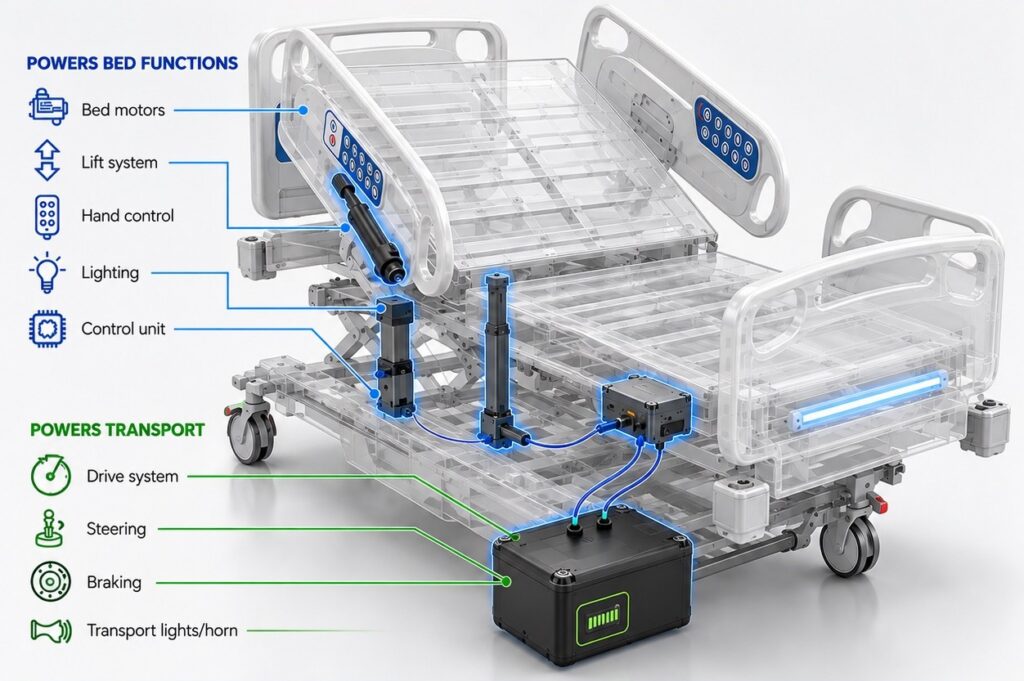
The problem compounds when a single lead acid battery is asked to do double duty. Many bed designs draw on one battery to power both the bed’s onboard functions — height adjustment, positioning motors, side rails — and the transport or mobility function that actually moves the bed from room to room. On paper, sharing one power source looks simpler and more cost-effective. In practice, it creates a real reliability gap: if the bed function has been drawing down the lead acid battery throughout the day, there may not be enough charge left to power transport when a patient actually needs to be moved. That’s exactly the moment a hospital bed can’t afford to run low on power, and it puts staff in the position of manually pushing a bed that was designed to move itself.
That gap is only getting wider as hospitals lean harder on powered transport. As nurses and staff recognize how much more efficient it is to move a patient directly in the bed rather than transferring them to a stretcher or wheelchair, transport features get used more often and for longer distances throughout a shift. That’s a good thing for staff and patients — but it’s hard on a lead acid battery. More frequent, deeper discharge cycles accelerate the degradation that lead acid chemistry is already prone to, shrinking usable capacity faster than the original spec assumed. The result is a battery that can’t reliably make it through a full day of real-world use, let alone the 24 to 36 months it was rated for, right at the moment hospitals are asking more of it, not less.
A Lithium Iron Phosphate (LFP) Solution That Fits
Lithium Iron Phosphate (LFP) batteries offer a compelling alternative. LFP chemistry is well known for its long cycle life which matters enormously in a hospital environment where equipment runs continuously and downtime isn’t an option.
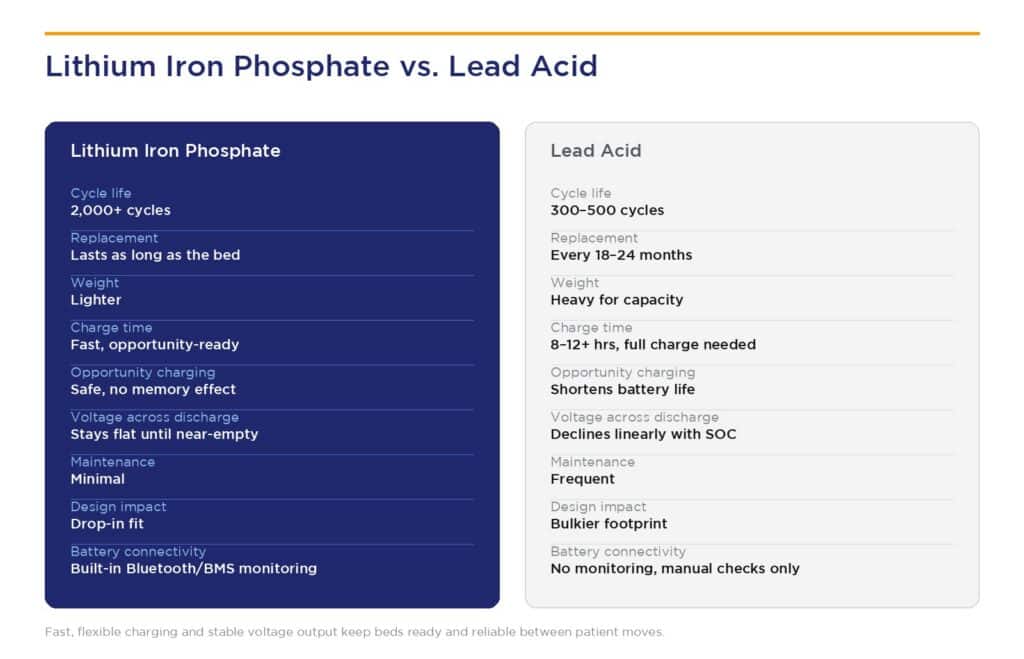
The benefits extend across everything the battery powers, not just transport. Height adjustment, positioning motors, side rails, and other onboard bed functions all draw on the same power system, and LFP handles that load more efficiently than lead acid — delivering more consistent power output as the battery discharges, rather than the gradual voltage sag that can affect motor performance as a lead acid battery wears down. Charging is a practical advantage too: LFP batteries charge significantly faster than lead acid and tolerate opportunity charging well, so a bed can be topped off between patient moves without the risk of shortening battery life the way partial or frequent charging does with lead acid. For a bed that’s relied on continuously across a shift, that combination of steady power delivery and flexible charging means both bed functioning and mobility stay dependable, not just one or the other.
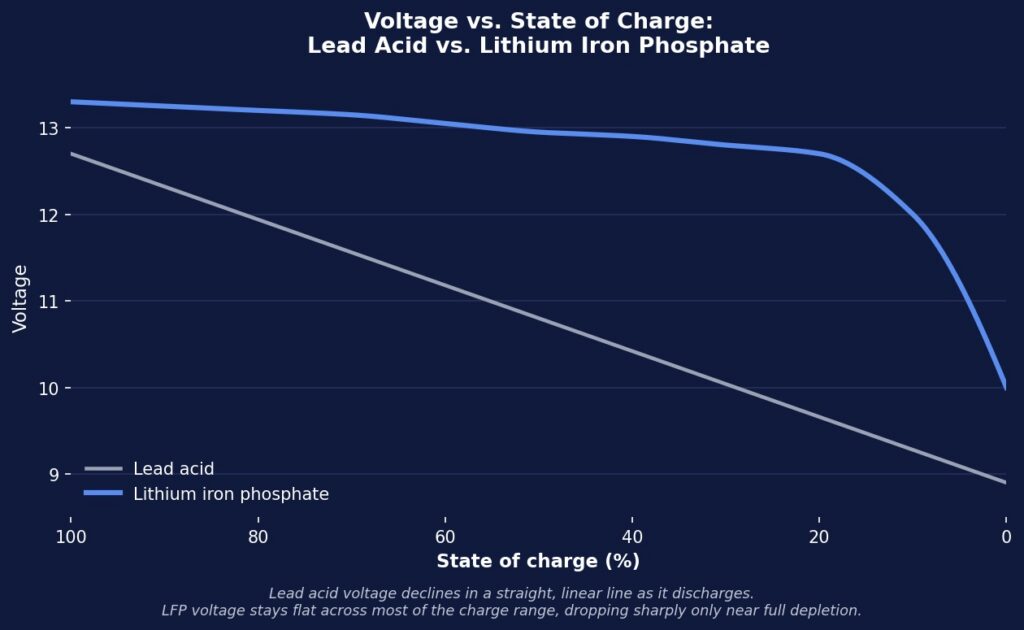
The underlying reason comes down to how each chemistry’s voltage behaves as it discharges. In a lead acid battery, voltage drops in a fairly direct, linear relationship to state of charge — as the battery discharges, voltage steadily declines right along with it. Once voltage falls below the threshold the bed’s electronics need to operate, the bed can’t be used, even if there’s technically some charge left in the battery. That linear drop-off is part of why lead acid beds can become unreliable well before they’re actually “empty.” LFP behaves very differently: its voltage stays relatively flat across most of the state-of-charge range, only dropping off sharply as the battery approaches full depletion. That means a bed running on LFP keeps delivering consistent power through most of its charge cycle, rather than gradually losing performance as it discharges — so staff can trust the bed to function normally right up until it actually needs a charge, not sometime well before.
This is where a dedicated, properly sized LFP power solution makes a meaningful difference — whether that means giving the mobility function its own battery or engineering higher-capacity lithium power that can reliably support both bed and transport functions without one competing with the other for the charge left at the end of the day. Patients and staff shouldn’t have to guess whether there’s enough power left to make the trip to radiology.
The most significant advantage for OEMs is straightforward: an LFP battery can outlast the bed itself. Instead of planning for a battery replacement every 24 to 36 months, OEMs and hospital systems can design around a power source that simply doesn’t need to be swapped out during the bed’s service life. That translates directly into lower total cost of ownership, fewer service calls, and less disruption to hospital operations.
Importantly, this doesn’t have to mean a ground-up redesign. A well-engineered lithium replacement can be built to work within an existing bed’s form factor, charging infrastructure, and mobility system — giving OEMs a path to better performance without re-engineering a platform that already works.
Why Partner with Inventus Power
Designing a battery system for a hospital bed requires meeting strict safety and regulatory requirements, performing predictably under continuous use, and holding up to the realities of a 24/7 clinical environment. For beds already in service, that battery also has to integrate seamlessly into a device that’s already been engineered, tested, and validated — with no room to redesign the platform around it.
Inventus Power brings decades of experience designing battery systems for medical OEMs across a wide range of applications, so we understand the quality expectations and regulatory rigor that critical care environments demand. That experience translates directly into how we approach bed mobility power:
- For next-generation bed designs, we work alongside OEMs from the earliest stages to engineer the optimal power solution into the platform itself.
- For beds already in service, we design lead acid replacement batteries that work within the existing mechanical and electrical architecture — no redesign required.
In both cases, the goal is the same: a safe, reliable, high-performance battery system that keeps beds moving and patients cared for, without the recurring cost and risk of lead acid.
The Bottom Line
Patients shouldn’t have to worry about a bed losing power mid-transfer, and hospitals shouldn’t have to budget for frequent battery replacements as the cost of doing business. For OEMs, that reliability shapes the everyday experience of the nurses and staff who depend on the bed, and ultimately the quality of care patients receive. A bed that consistently performs when it’s needed builds trust in the equipment and the people using it; one that doesn’t put that trust, and patient care, at risk. A lithium iron phosphate solution addresses both problems — extending battery life beyond the life of the bed, reducing maintenance costs, and giving hospitals the reliability they depend on.
If your team is evaluating power options for a current or next-generation bed platform, Inventus Power can help you find the right fit — whether that means a custom-engineered solution built into a new design or a drop-in lead acid replacement for the fleet you already have in the field.